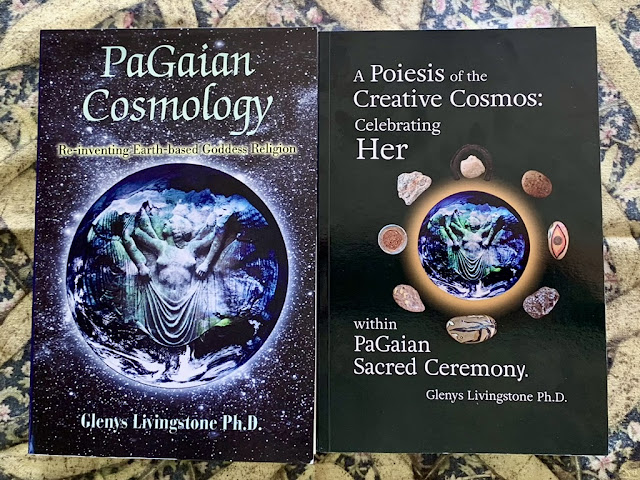
“I first read PaGaian Cosmology in 2016, and though it made quite an impression at the time, there were definitely aspects of it that I didn’t fully understand, or which were still a little bit too challenging to fully embrace. Returning to it now with greater understanding, however, I am grateful for the perspective it offers, for it affirms the inklings and thoughts I’ve been having for some time …
… Glenys Livingstone used to live in the Blue Mountains where I reside, and the search/research that she devoted herself to, and the celebration of the Seasonal Moments of the Wheel of the Year which form the basis of her cosmology, initially took place here. There is, therefore, an organic resonance between her ceremonial creations and this place. The way in which she describes her upbringing also echoes some of my own feelings about my childhood:
I was perhaps one of Earth’s most alienated of beings, and by that I mean that I did not sense belonging Here. My cultural context was such that I had no sense of relationship with my earthly and cosmic habitat. Cultural circumstance and story built over millennia converged to create a human who did not know her Place much at all—this included the place within my own skin, as much as the place in which I dwelt. (p. 1)
Being raised Christian in a colonised land, with all of those connotations, without the long-held traditions of the Northern Hemisphere, which at least retained some link to the land, ‘the children here … inherited a poverty of spirit, a deep divorce from Earth that few other religions in the history of Gaia have known’ (pp. 2-3). This is compounded by the fact that the traditional yearly festivities (and even much pagan/Earth-based ritual) are still practiced from the Northern Hemisphere perspective, meaning that in the Southern Hemisphere Yule/Christmas is celebrated in summer, the rebirth of Eostar/Easter takes place in autumn, and the imagery of pumpkins and autumn leaves at Samhain/Halloween is in high spring. It’s all very upside down and inside out. As Livingstone says,
There is consistent failure to take into account a whole Earth perspective: for example the North Star does not need to be the point of sacred reference (there is great Poetry to be made of the void of the South Celestial Pole) nor the North rigidly associated with the Earth element and darkness, nor is there really an “up” and a “down” cosmologically speaking. A sense and account of the Southern Hemisphere perspective with all that that implies metaphorically as well as sens-ibly, seems vitally important to comprehending and sensing a whole perspective and globe—a flexibility of mind, and coming to inhabit the real Cosmos, hence enabling a PaGaian cosmological perspective. (p. 17)
This ‘whole-Earth perspective’, as Livingstone asserts, is somewhat easier for people of the Southern Hemisphere to grasp due to this frustrating displacement of seasonal imagery and experience. Because the northern perspective has never made sense in our own context, we also more easily come to the realisation ‘that the whole Creative Dynamic happens all the time, all at once. The “Other”, the opposite, is always present—underneath and within the moment.’ (p. 16) As we celebrate the Summer Solstice and the birth of the Dark here, the Winter Solstice and the birth of the Light is taking place simultaneously on the other side of the globe. …”


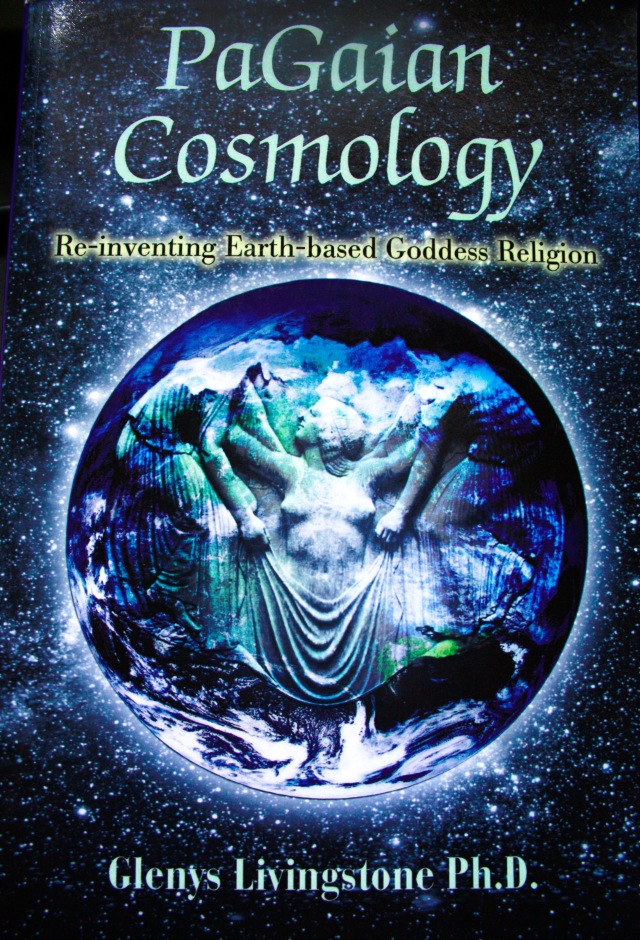

 PaGaian Cosmology